
LAION-Audio-XL and CLAP2
LAION-5B and OpenCLIP gave vision open web-scale data and reproducible scaling laws. LAION-Audio-XL and CLAP2 bring the same to audio.
We release LAION-Audio-XL, a web-scale audio-text corpus, together with CLAP2, a family of five contrastive language-audio models trained on it.
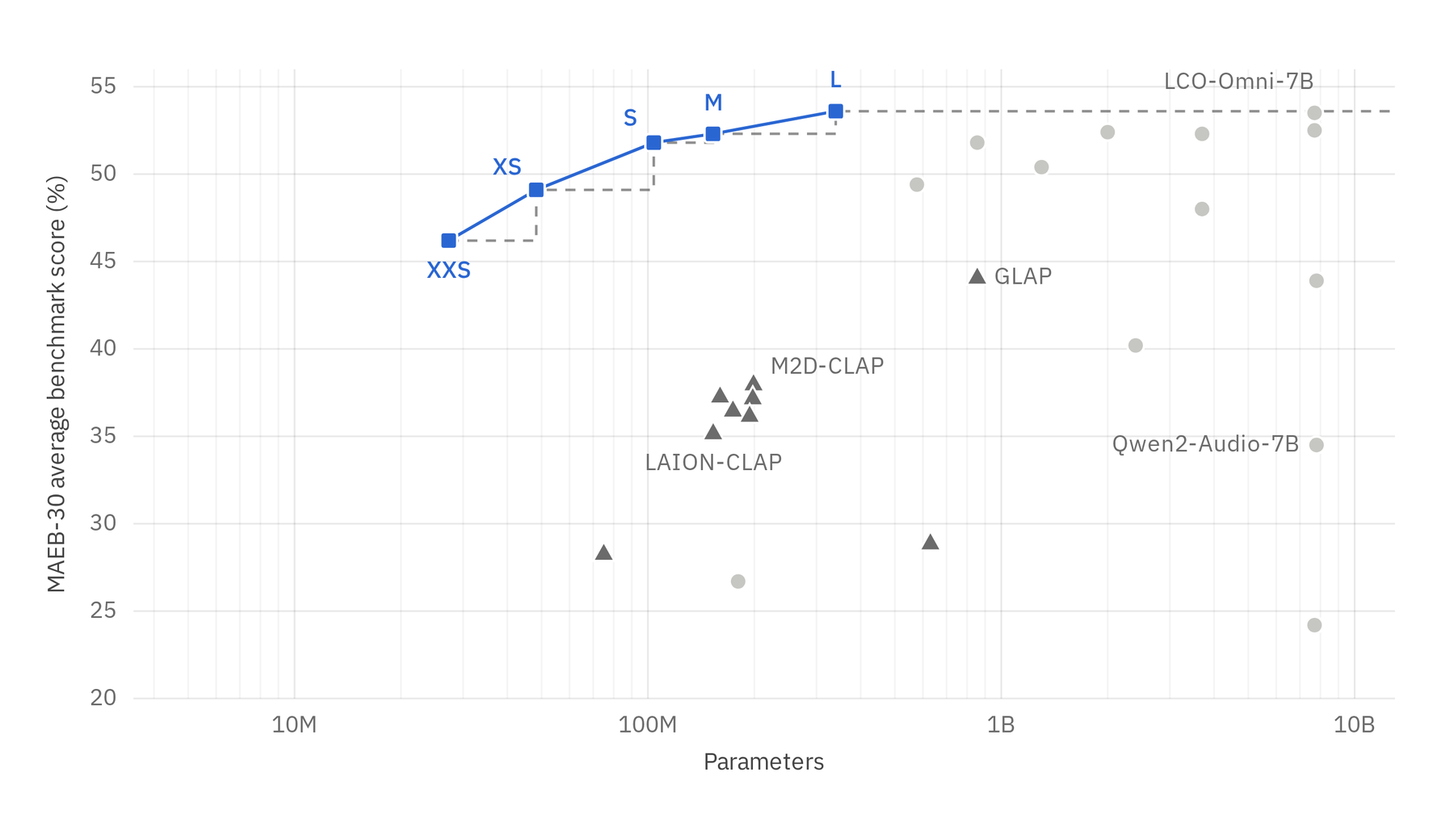
CLAP2 comes in five sizes, from 27M to 340M parameters, all trained from scratch on LAION-Audio-XL. The largest, CLAP2-L, reaches 53.6% on MAEB-30, a benchmark of 30 speech, music and sound tasks. That is the best score of any model trained from scratch on the MAEB leaderboard, and the smallest, CLAP2-XXS, already beats every earlier CLAP-style model, including GLAP, which is 31× larger.
Dataset, captions, model checkpoints and code are all open: paper, project page, code, dataset, models.
Why LAION-Audio-XL?
Recent advances in contrastive audio-language models come mainly from the scale and quality of their training data. Compared to vision and language models, open-weight audio models remain underscaled. Larger training sets expose models to a broader range of sounds and the words people use to describe them. But the training data behind several recent audio models is not released, and the largest open audio-text corpora so far have fewer hours of audio and fewer captions.
Building the Dataset
We collected 1.48 billion audio clips from YouTube, Common Crawl and other web collections, 316 academic datasets and further internet datasets. All audio is converted to 32 kHz mono and cut at silence into clips of up to 120 seconds.
The curation pipeline then runs in four steps:
- Clean: silent or unreadable audio is dropped, exact and near-duplicates are removed, and clips that overlap evaluation sets are filtered out.
- Annotate and select: expert models tag every clip with a sound category and signal statistics, and add language, speaker, emotion, music or species information where it applies. Selection keeps 500M clips that cover a 3,718-class sound taxonomy, thinning common content and protecting rare categories.
- Caption: two audio language models, Qwen3-Omni-30B-A3B-Instruct and MOSS-Audio-8B-Thinking, listen to each clip that has no text yet, read those annotations and write a short and a long caption.
- Keep clips up to 30 seconds: this subset, LAION-Audio-XL, is what we train on. Limiting clips to 30 s gave better benchmark results at 3.5× less compute than training on all 500M clips.
What is in it
We group LAION-Audio-XL into a sound taxonomy with 11 top-level groups and 3,718 classes spanning a wide variety of audio domains. Across four broad domains, speech makes up 44.8% of the clips and music 22.4%; the rest is sound effects (16.6%) and other sounds (16.2%), from birds and machinery to kitchens and stadiums.
On the project page you can open each of the 11 groups and listen to example clips.
Most of the selected clips come without captions. We generate text descriptions for 471M clips. In particular, a set of small expert models first annotates each clip: a taxonomy classifier and signal statistics for every clip, then specialists depending on the predicted category, such as language, speaker age and gender, emotion and pitch for speech, genre, tempo and key for music, and species for animal sounds. The captioning model receives the audio together with these raw annotations and writes a short caption (12 words on average) and a long one (29 words on average).
Here is one clip of German studio speech, with the annotations the captioning model received and the two captions it wrote:
Compared with other corpora
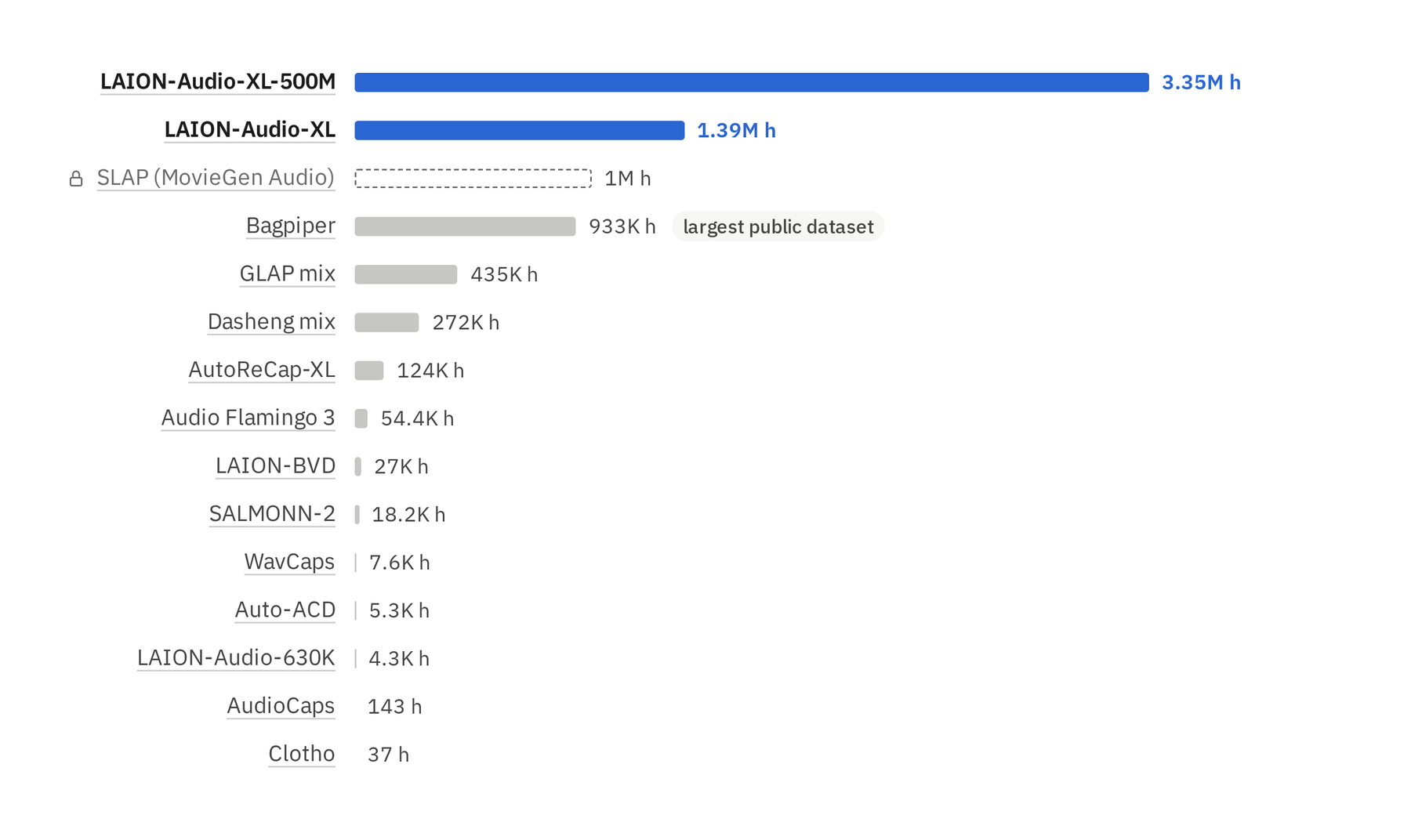
LAION-Audio-XL has more hours of audio and more captions than any other public audio-text corpus. The 500M selection it is cut from, with clips up to 120 s, is larger still: 3.35M hours and 970M captions.
CLAP2: The Models
In contrastive language-audio pretraining (CLAP), models learn to map audio recordings and their corresponding text descriptions into a shared embedding space. CLAP2 is a dual encoder in the CLAP family. One tower turns a sound into a vector, the other turns text into a vector, and the cosine similarity between the two says how well they match. This enables text-to-audio search, zero-shot classification and the use of CLAP2 embeddings as audio features in downstream systems.
The audio tower is a NaFlex vision transformer over log-mel spectrogram patches: every 16 × 16 patch becomes one token, 50 tokens per second, so each clip is read at its own length up to 30 seconds instead of being padded or cropped to a fixed window. Both towers are trained from scratch and therefore don’t depend on pretrained weights. This makes our training recipe transparent and flexible for our scaling study.
Scaling Laws
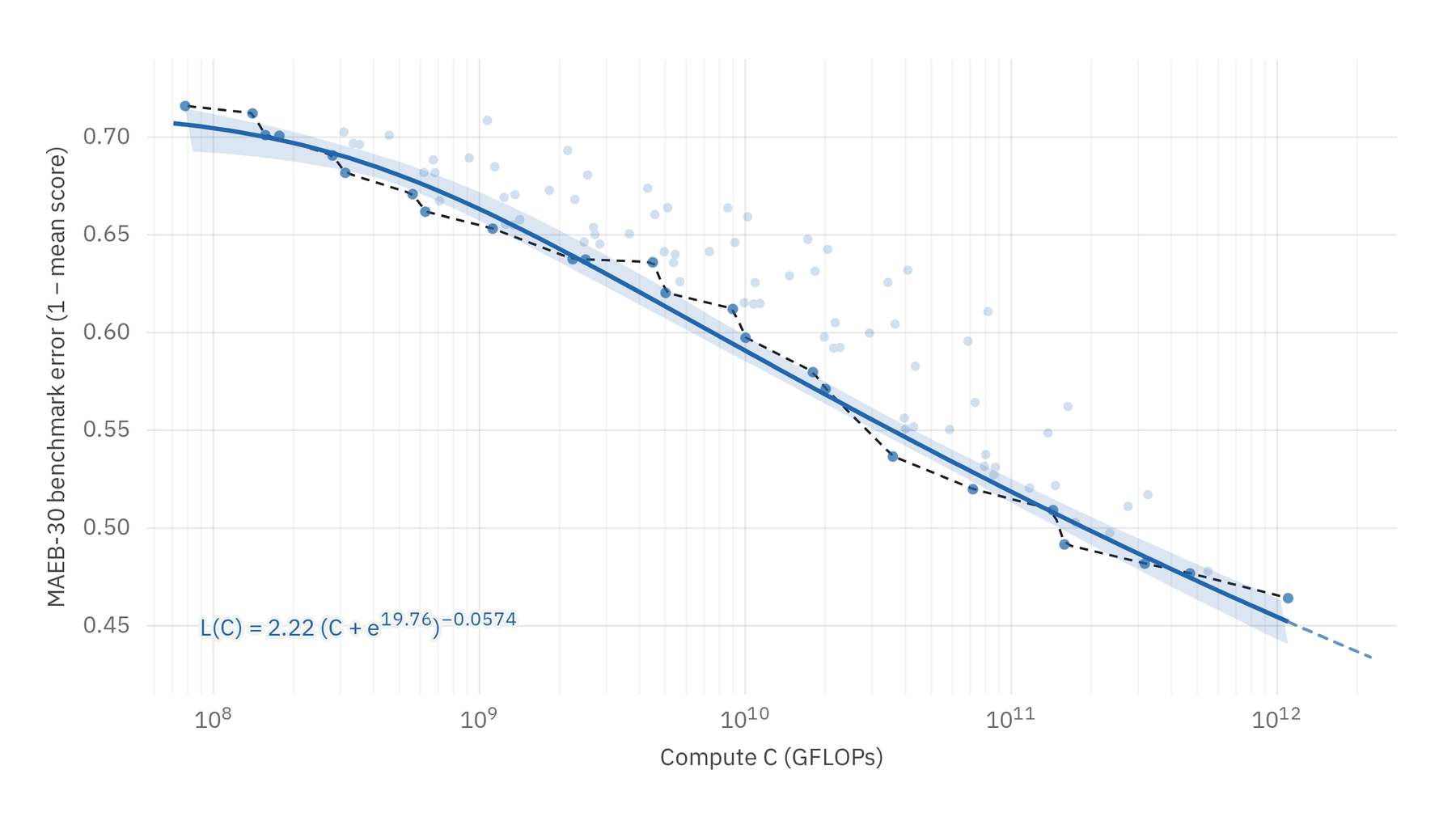
We trained all five model sizes on 1M to 1,024M samples seen and measured how the MAEB-30 error falls with training compute. It follows a smooth power law: each doubling of compute lowers the error by 3.9%, about +1.8 MAEB-30 points at the largest budget.
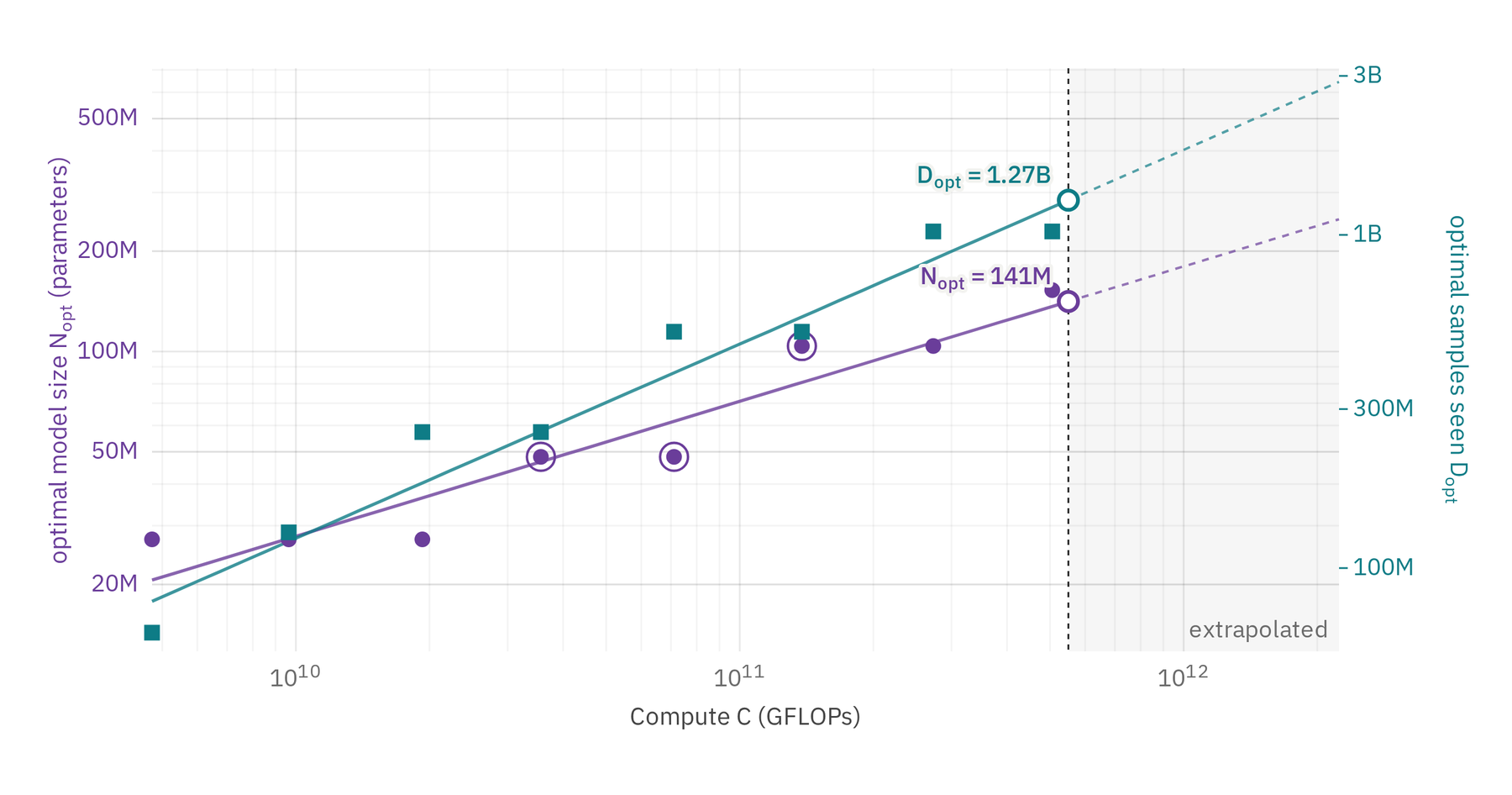
The fit also tells us how to spend a fixed budget. The compute-optimal model size grows as C0.405, the optimal amount of training data as C0.583: data should grow about 1.4× faster than the model. With more compute, most of it should go into more data rather than a bigger model, which is exactly why a corpus of this size matters.
Results
Four years of CLAP-style models, from wav2clip in 2021 (28.3%) to GLAP in 2025 (44.1%), raised the best MAEB-30 score by 16 points. CLAP2-L adds 9.5 more.
CLAP2 is also the best choice at its size. On MAEB-30, CLAP2-XXS to CLAP2-M (27M to 153M parameters) are only beaten by models with at least 8× more parameters. On HEAR (17 tasks), CLAP2-S to CLAP2-L score higher than every other audio-text model. Omni-embedding models with 1B to 9B parameters reach up to 53.5% on MAEB-30, but they are not drop-in CLAP replacements.
| Model | Params | MAEB-30 | HEAR |
|---|---|---|---|
| CLAP2-L | 340M | 53.6 | 81.9 |
| CLAP2-M | 153M | 52.3 | 81.4 |
| CLAP2-S | 104M | 51.8 | 81.8 |
| CLAP2-XS | 48M | 49.1 | 80.6 |
| CLAP2-XXS | 27M | 46.2 | 79.1 |
| jina-embeddings-v5-omni-nano | 855M | 51.8 | 80.7 |
| EmbeddingGemma 2 | 577M | 49.4 | 69.1 |
| GLAP | 855M | 44.1 | 71.8 |
| M2D-CLAP | 199M | 38.0 | 80.6 |
| TP-CLAP | 198M | 37.2 | 76.6 |
| LAION Larger CLAP | 194M | 36.2 | 69.5 |
| LAION-CLAP HTSAT unfused | 153M | 35.2 | 69.2 |
MAEB-30 and HEAR scores (%) of CLAP2 and other audio-text models below 1B parameters. The full table, with more baselines, is on the project page.
Get Started
The project page has interactive versions of every figure in this post: play clips from each sound group, trace how a clip gets its captions, drag the compute budget through the scaling laws, and ask questions about the paper. To work with CLAP2 and LAION-Audio-XL yourself: the models load with OpenCLIP, and the dataset is accessible via Hugging Face.
Licence and Access
The dataset comes in open, share-alike and non-commercial configurations. Clips crawled from the web are not redistributed: they are listed as links in laion/laion-audio-xl.