LAION-BVD: A 10-MILLION-HOUR OPEN VIDEO DATASET FOR MULTIMODAL RESEARCH
by: Andreas Hochlehnert, Marianna Nezhurina, Mehdi Cherti, Andrej Radonjic, Thaddäus Wiedemer, Christoph Schuhmann, Romain Beaumont, Wieland Brendel, Bernhard Schölkopf, A. Sophia Koepke, Jenia Jitsev, Matthias Bethge, 26 Aug, 2026
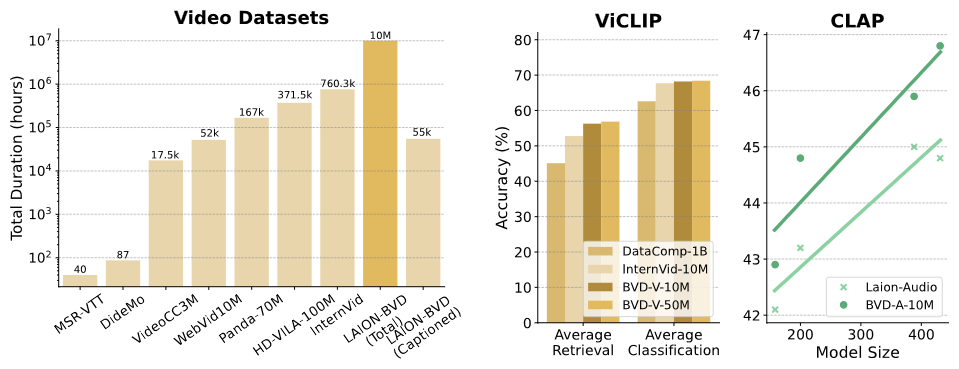
Today we are releasing LAION-BVD (Big Video Dataset), a large-scale open video dataset designed for multimodal machine learning research.
LAION-BVD contains:
- 1.3 billion platform-specific video URLs collected from Common Crawl
- 80 million downloaded videos
- 10 million hours of video content
- 55 million captioned video clips
- 300 million captioned video frames
The dataset is intended for research on video-language, audio-language, and image-text models.
Why LAION-BVD?
Large-scale multimodal datasets are increasingly concentrated inside a small number of technology companies. Open image-text datasets such as LAION-5B helped make reproducible vision-language research broadly accessible. Comparable open resources for video remain much smaller and harder to construct at scale.
LAION-BVD aims to provide an open foundation for multimodal research across video, audio, and image modalities.
Building the Dataset
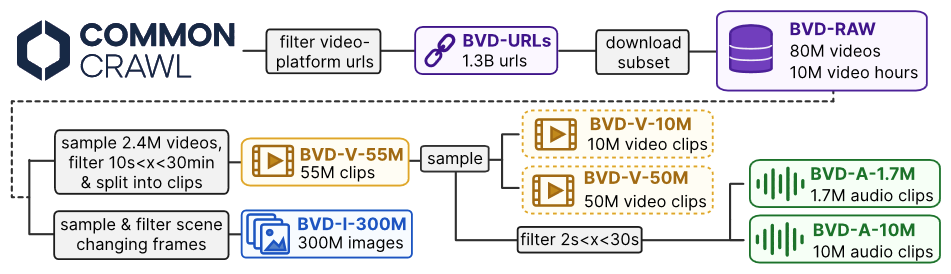
We started from Common Crawl WAT files and extracted platform-specific video URLs using yt-dlp extractors. Using a distributed Apache Spark pipeline and large-scale download infrastructure, we processed video links from YouTube, Vimeo, and Dailymotion.
From 1.3B extracted video URLs, we downloaded a subset of around 80M videos corresponding to roughly 10M hours of content.
We then created several multimodal subsets:
- BVD-V-55M: 55M scene-level video clips with generated captions
- BVD-A-10M and BVD-A-1.7M: captioned audio subsets
- BVD-I-300M: 300M scene-changing video frames for image-text training
Our pipeline uses scene detection and lightweight filtering to extract clips and keyframes at scale. Video and audio captions are generated automatically using multimodal captioning models.
Dataset Statistics
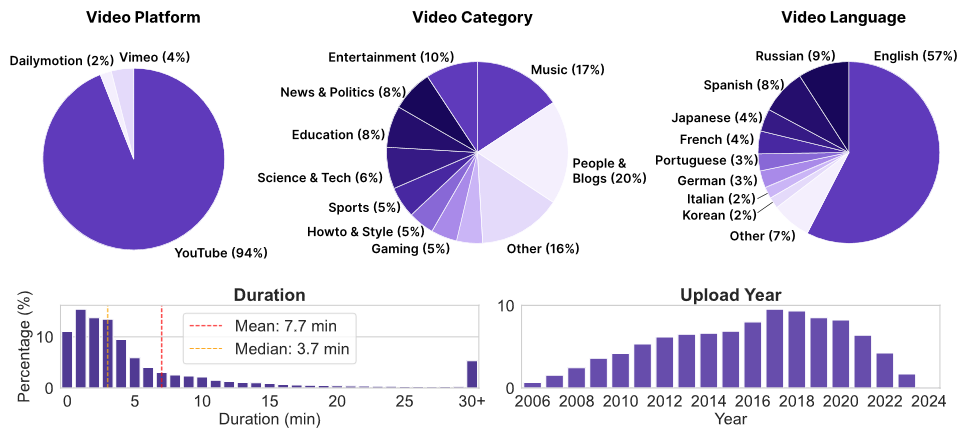
LAION-BVD spans a broad range of languages, topics, and video formats. While English is the largest language group, 43% of the videos are non-English. The dataset includes entertainment, education, science, sports, music, gaming, and many other categories.
Most videos are shorter than five minutes, but the distribution is long-tailed and includes longer-form content suitable for long-horizon video tasks.
Video, Audio, and Frame Captioning
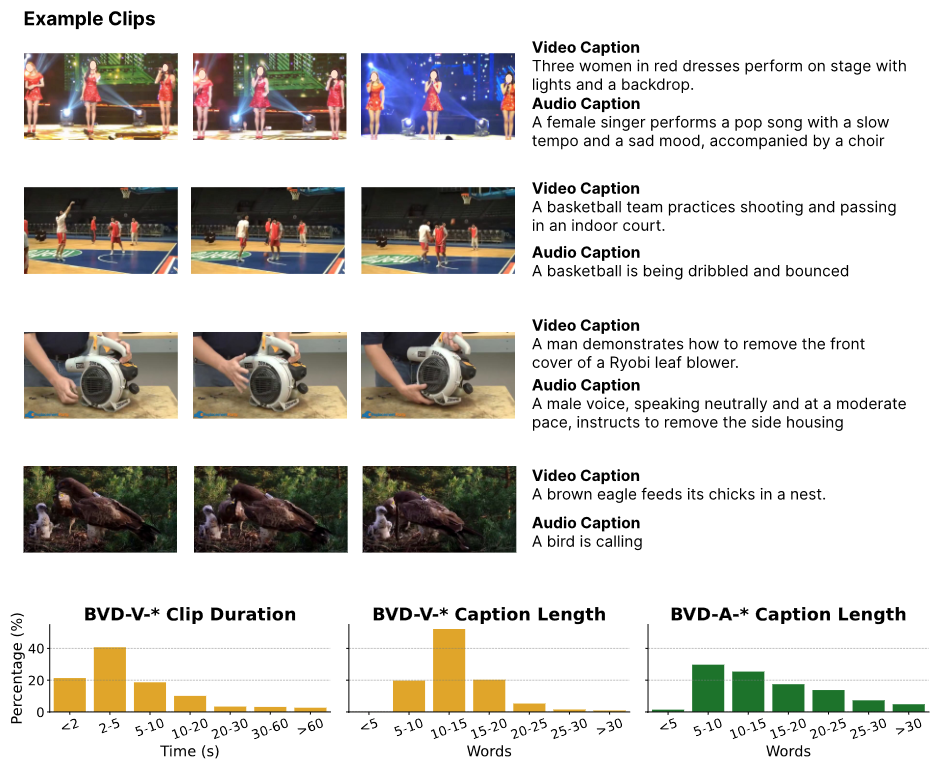
To construct training data across modalities, we segment videos into scene-level clips and generate captions automatically.
For video-language training, we caption clips using Qwen3-VL. For audio-language training, we generate audio captions using Audio Flamingo 3. We additionally extract and caption scene-changing video frames for image-text training.
Validation Across Modalities
We evaluate LAION-BVD across three modalities:
- video-text with ViCLIP
- audio-text with CLAP
- image-text with CLIP
Our experiments show:
- ViCLIP models trained on LAION-BVD outperform InternVid-trained baselines by up to 3.3 percentage points on aggregate retrieval and classification benchmarks (Table 1, BVD-V-10M vs InternVid-10M-FLT)
- CLAP models trained on BVD audio achieve competitive performance despite minimal curation (Table 2)
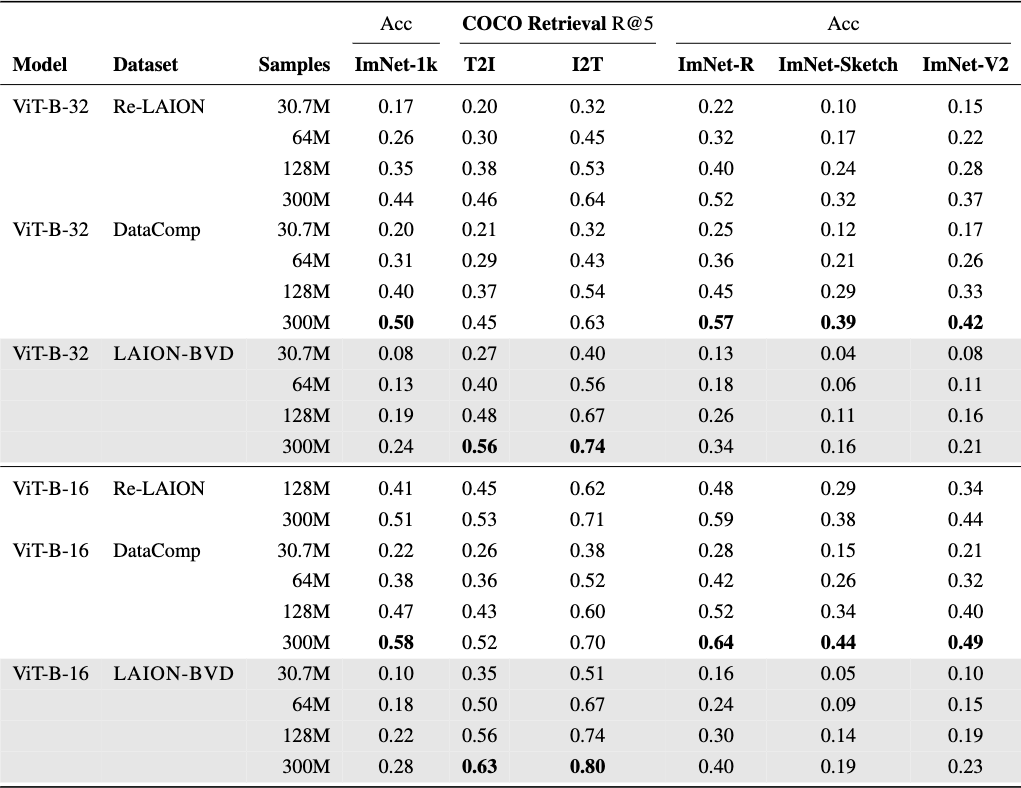
- Frame-caption pairs extracted from videos provide strong image-text retrieval performance and favorable scaling behavior (Table 3)
Across modalities, we observe consistent improvements with increasing data and model scale.
Table 1: L-14 scaling with LAION-BVD data on classification and retrieval tasks.
LAION-BVD-trained ViCLIP outperforms both InternVid-trained ViCLIP and the image-only CLIP baseline trained on DataComp-1B where video embeddings are obtained by averaging frame embeddings. Performance consistently improves with increased training data and dataset scale, with BVD-V-50M achieving the best overall average. (* denotes results reported in InternVid; all other results are evaluated using our pipeline.)
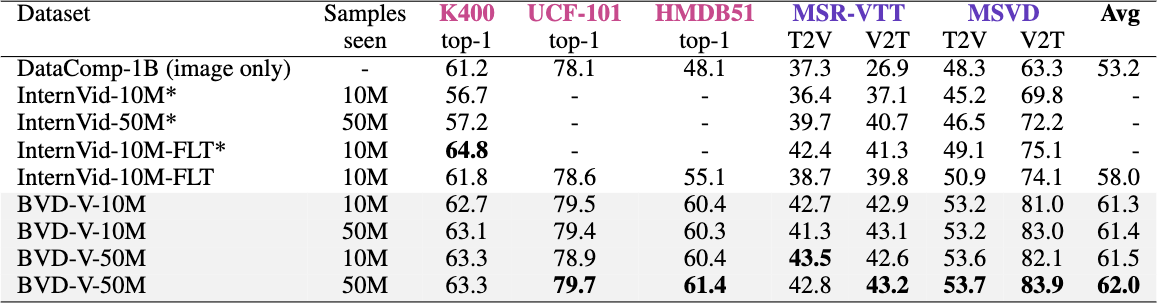
Table 2: Average zero-shot audio performance for pure training data sources at 30M samples seen.
Each cell reports the best average score per model scale, aggregated over UrbanSound8K classification and AudioCaps/Clotho retrieval. LAION-BVD audio matches or exceeds LAION-Audio (LA) across model scales. Despite minimal curation, BVD-A-10M exhibits consistent scaling behavior with increasing model size.

Table 3: Image-text training with CLIP across datasets and scales.
LAION-BVD achieves the strongest COCO retrieval results, while web-image datasets remain stronger on ImageNet-style classification.
Research Access and Responsible Use
LAION-BVD is released to support open and reproducible multimodal research at scale. Large-scale video datasets and the models trained on them are increasingly concentrated within a small number of predominantly US-based technology companies, limiting independent scientific investigation and reproducibility.
By providing an open resource for academic research, we aim to broaden access to multimodal training data and enable more transparent evaluation of large-scale video, audio, and image models.
LAION-BVD is released exclusively for research purposes and NOT for commercial use. We strongly encourage users to respect the rights and copyright of content creators and to use the dataset responsibly and in accordance with applicable laws and platform terms.
The dataset is intended to support scientific research, reproducibility, safety analysis, and the study of multimodal foundation models and systems built on them.
Like other large-scale web datasets, LAION-BVD may contain biases, stereotypes, or uneven representation across languages, regions, and topics. Depending on the learning procedure, models trained on this data may develop representations that inherit such biases, expressing those to various degrees under various circumstances. Researchers working with the data should be aware of these phenomena and whenever relevant in the context of research work, quantify and highlight such limitations alongside the strengths when developing and evaluating multimodal systems.
Release
We release:
- the URL collection
- video, audio, and frame captions
- subset metadata
- training code and evaluation details
Our goal is to lower the barrier for open multimodal foundation model research and provide infrastructure for reproducible large-scale video learning.
Website: https://projects.laion.ai/bvd/
Dataset collection: https://huggingface.co/collections/laion/bvd-big-video-dataset
Terms of use: https://github.com/LAION-AI/BVD/blob/main/assets/bvd_terms_of_use.pdf
Privacy policy: https://github.com/LAION-AI/BVD/blob/main/assets/bvd_privacy_policy.pdf
We are excited to see what the research community builds with LAION-BVD.
We also thank GRASS for providing LAION access to its data infrastructure in support of this release.